
Is Day of the Dead Mexican Halloween? The History Behind Día de Muertos
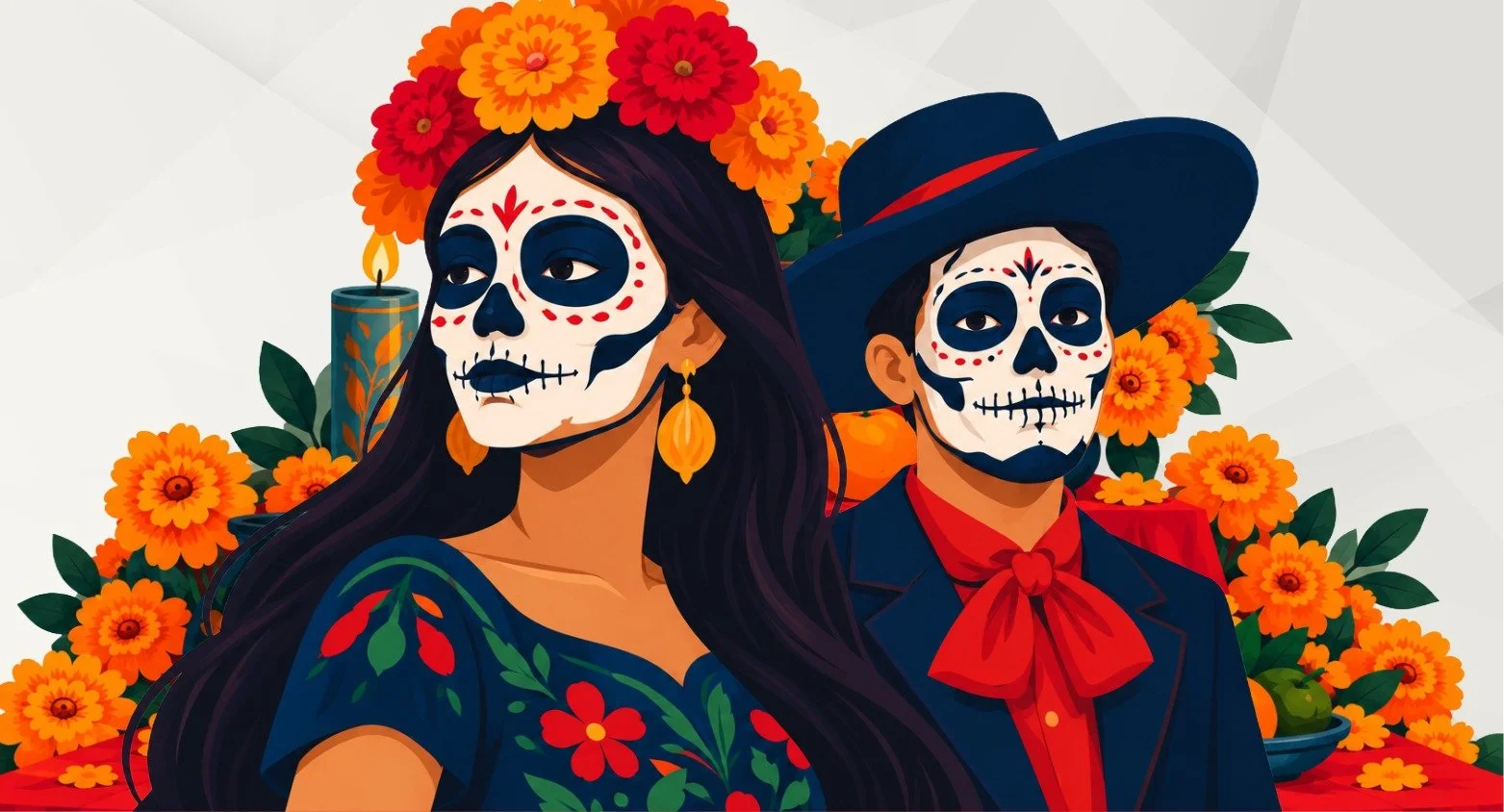
Ever since I came to Canada, I've always wanted to share my culture with my friends and family. This year, I'm doing it through social media and the internet, which is very different from sharing it with a small group of people. Now I have the opportunity to share what I know with so many people I wouldn't otherwise reach, and that means a lot to me, especially when it comes to a tradition I hold very dear to my heart.
My original idea was to make an educational YouTube video, so I spent a lot of time researching. Then I realized that if I wanted to share everything I'd learned, I would basically have to make a mini-documentary! I ended up making a two-minute reel instead, which was much more doable (you can watch it if you scroll to the end of this article). And just like with my Hispanic Heritage Month and Thanksgiving videos, after making the reel, I realized I needed to give all that research a home.
And this is your lucky day, because I'm about to take you on a journey through time, all the way from Mesoamerica to the present day. But first, let's answer the big question: Is Day of the Dead Mexican Halloween?
No, it isn't!
Halloween is actually very popular in Mexico, and although both celebrations happen around the same time and share imagery like candles and skulls, they have very different histories and meanings.
Día de Muertos is a beautiful tradition rooted in Indigenous traditions that has survived until today and is mostly about remembering and honouring those who are no longer with us.
While doing this research, I couldn't help but notice the parallels between colonization here in Canada and in Mexico, and how it affected Indigenous peoples, their ancestral traditions and their ways of life.
How Indigenous beliefs and Catholicism blended
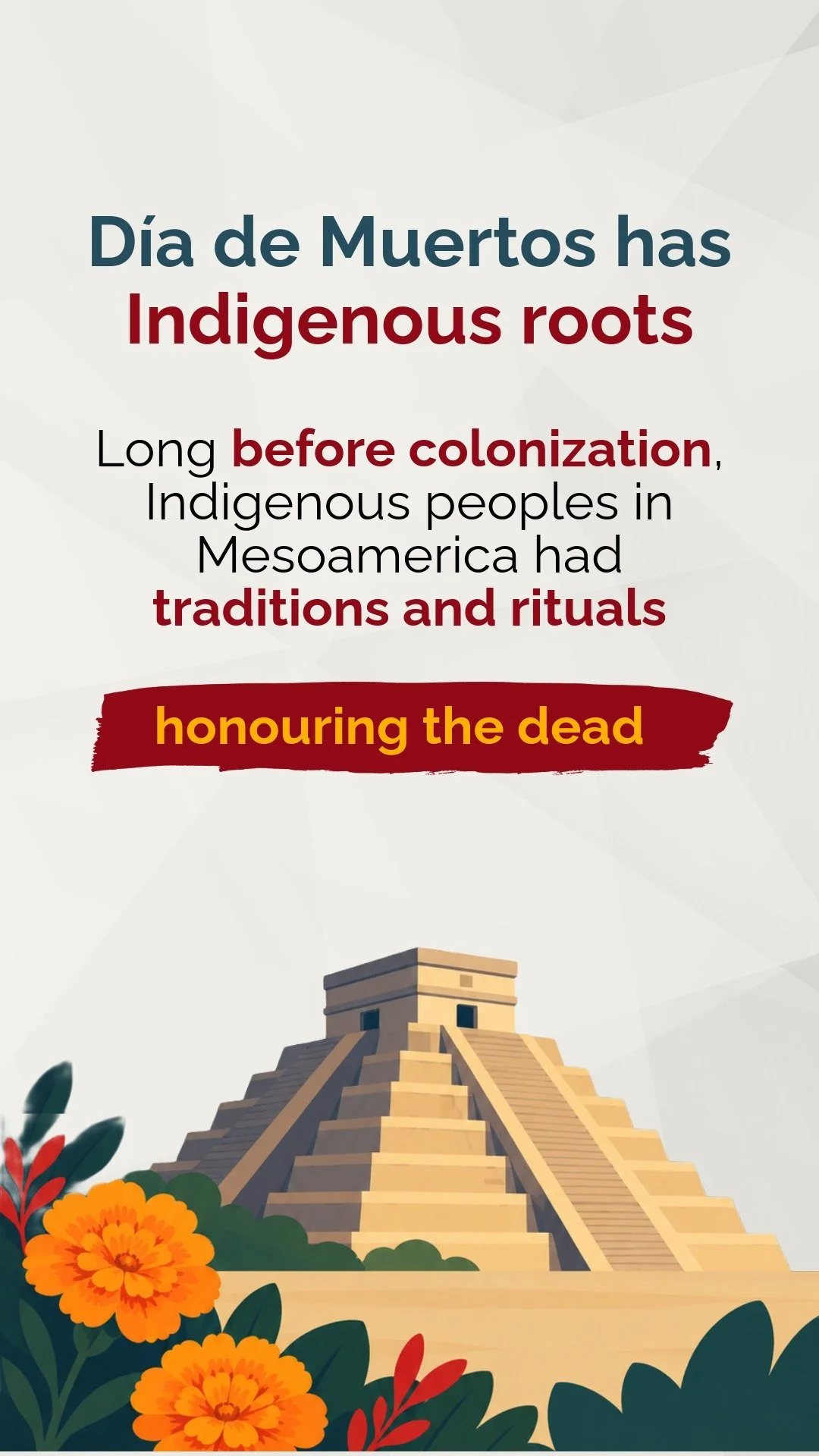
So, let's start our journey long before colonization, when Indigenous peoples across Mesoamerica had their own beliefs, ceremonies and traditions surrounding death.
One example comes from the Mexica (Aztecs). In their mythology, death wasn't the end; it was the beginning of another journey. They believed many of the dead had to travel through the underworld to reach Mictlán, the realm of the dead. If you've watched the movie Coco, this idea might sound familiar. And here's a fun fact: while the movie draws on Mexican traditions surrounding death, the colourful Land of the Dead you see in the film was partly inspired by the city of Guanajuato in Mexico.
Back to the Aztecs. Families buried or cremated their loved ones with objects and offerings to help them on this difficult journey, showing that their connection with them didn't end when they buried them.
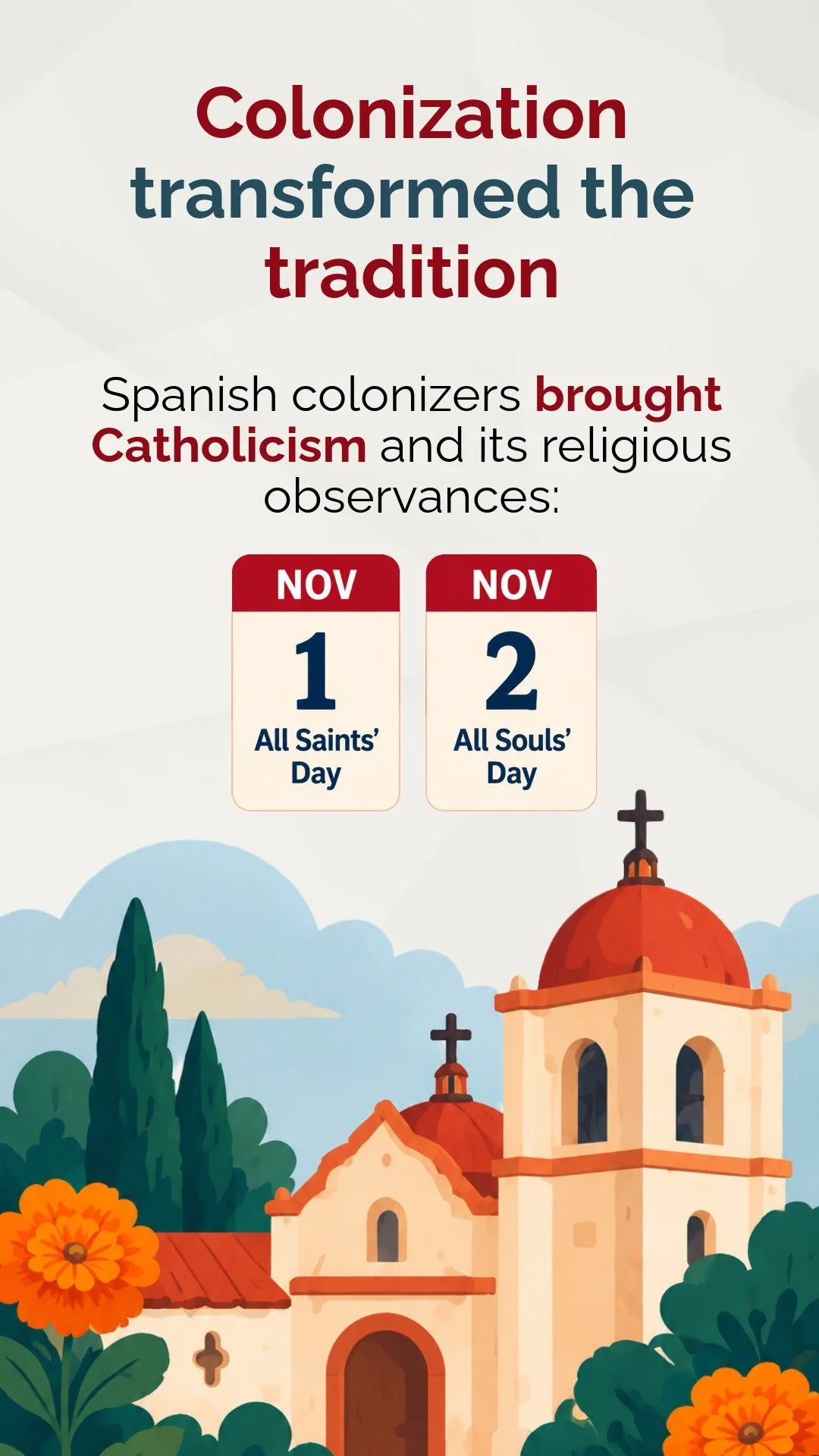
Everything changed when the Spanish arrived in the 16th century. Indigenous religious practices were suppressed, and people were forced to adopt Catholic beliefs. But traditions that had existed for generations were hard to erase.
Over time, some Indigenous traditions surrounding death became intertwined with the Catholic observances of All Saints' Day and All Souls' Day on November 1 and 2. Some traditions survived, but they also changed.
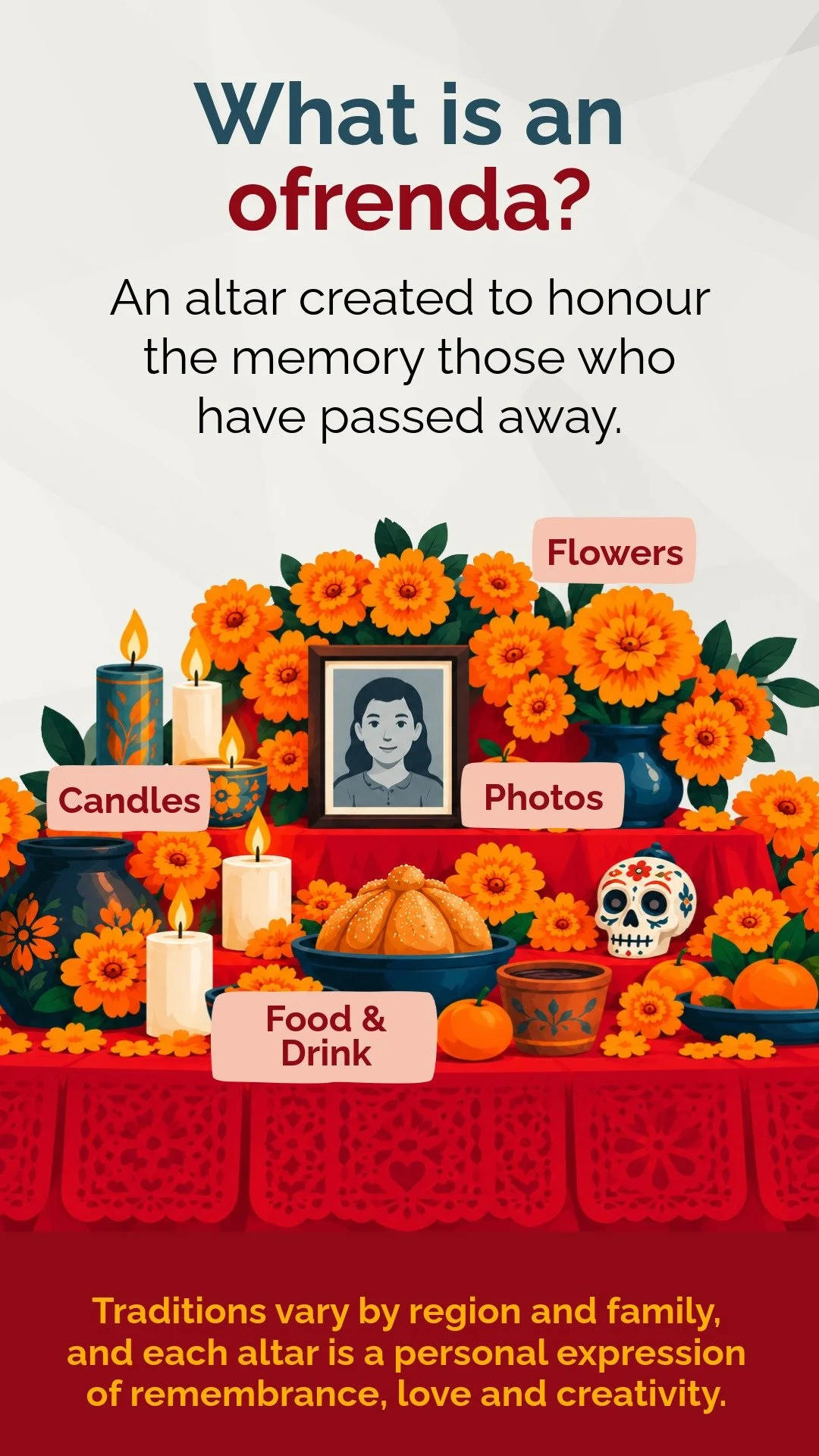
What is an ofrenda?
One of the most recognizable parts of Día de Muertos is the ofrenda, an altar created to honour loved ones who have passed away.
According to tradition, the souls of our loved ones return to visit us during Día de Muertos, and the ofrenda is a way of welcoming them home. (Yes, another Coco reference! If you haven't watched it, I highly recommend it. And no, this blog post isn't sponsored by Disney. I wish!)
The elements on an ofrenda vary, but some of the most common ones are:
Photographs of loved ones being remembered.
Candles to light their way.
Cempasúchil (marigolds), whose colour and fragrance are believed to help guide the souls.
Food and drinks, preferably their favourites.
Water to refresh them after their journey.
Pan de muerto, a traditional, delicious sweet bread.
Copal incense, used in ceremonies since pre-Hispanic times.
Personal objects that remind us of them.
Papel picado, the colourful traditional tissue paper decorations.
And here's something I really want to emphasize: Not every ofrenda looks the same. Traditions vary from region to region and family to family. Some people build elaborate altars, others keep them simple, and some families don't build one at all.
When I made my first altar, I was quite late setting it up and didn't have printed pictures, so I literally cut my own papel picado (poorly!) and wrote the names of my family members. Nowadays, this is something I plan in advance, and just as people have their Christmas decoration box, I have a Día de Muertos box, much to the chagrin of my poor husband, who has to find somewhere to store my ever-growing collection of Day of the Dead decorations.
La Catrina: The famous skeleton with a loaded meaning
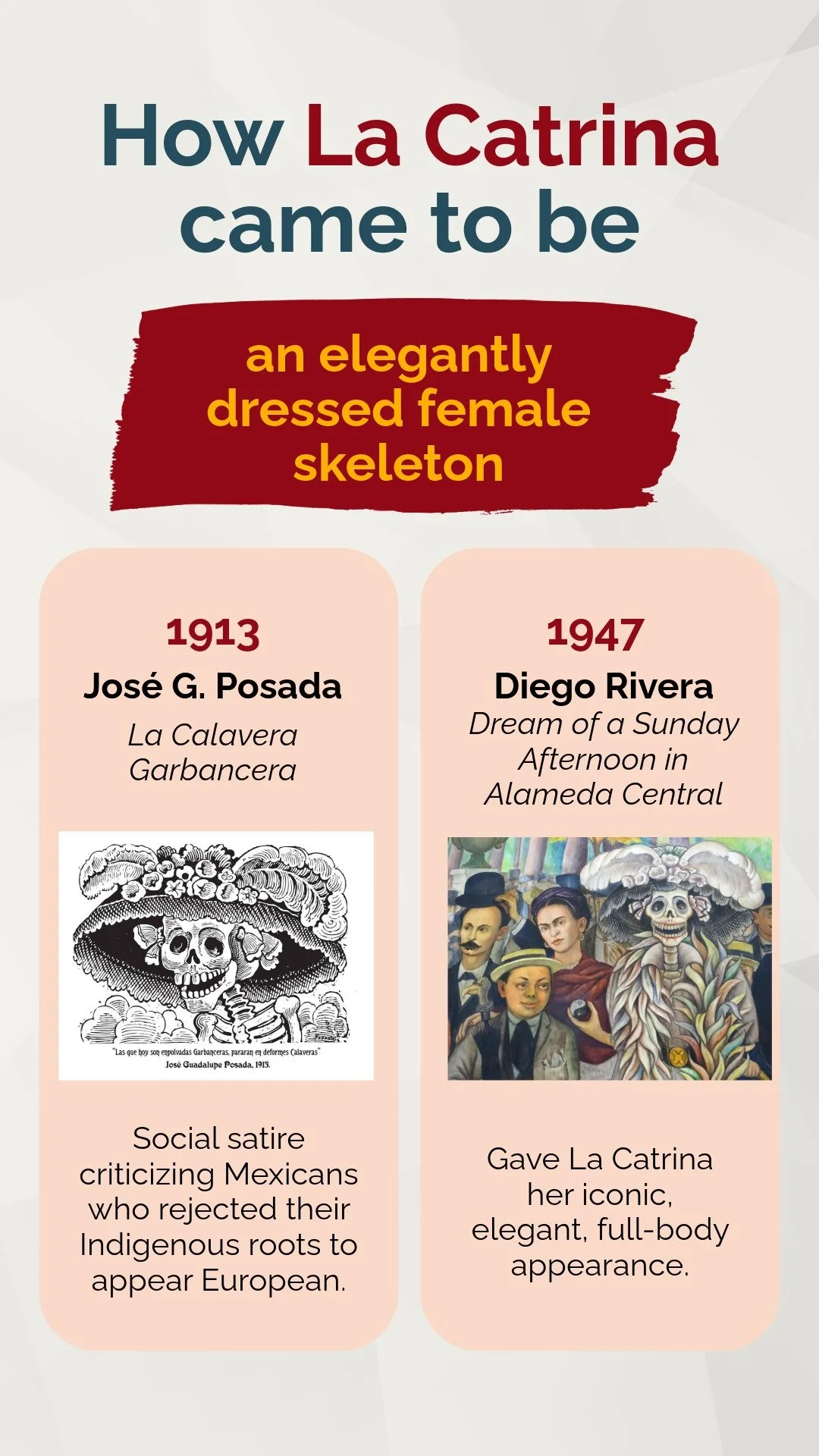
La Catrina, the elegantly dressed skeleton with a hat and elaborate makeup, has become one of the most recognizable symbols of Día de Muertos. But did you know she actually originated as a social satire?
In the early 1900s, Mexican illustrator José Guadalupe Posada created La Calavera Garbancera, a skeleton wearing an extravagant European-style hat.
This illustration was meant as social satire, criticizing Mexicans who rejected their Indigenous heritage in order to appear European or belong to a higher social class, and the message behind it was: Death comes for everyone, regardless of wealth or social status.
But there's more to it. Posada's original illustration was just a skull wearing a hat. So where did the elegant skeleton we know today come from?
Enter Diego Rivera
In 1947, famous Mexican muralist Diego Rivera (yes, Frida Kahlo's husband, and I love that we now reference him through her rather than the other way around!) included Posada's skeleton in his mural Dream of a Sunday Afternoon in Alameda Central.
He gave her a full body, an elegant dress and the appearance we now recognize as La Catrina. Eventually, she became closely associated with Día de Muertos, even though her origins were in social satire.
And what about El Catrín? He's the elegantly dressed male skeleton often seen alongside La Catrina. The word catrín originally referred to a fashionable, well-dressed man. Today, both are recognizable characters in Día de Muertos art, costumes and celebrations.
Now you know the origins of La Catrina, but when did face painting and dressing as skeletons become so popular?
The Chicano movement and the Día de Muertos we recognize today
And here's something else I discovered while researching this topic, which I found especially interesting as an immigrant.
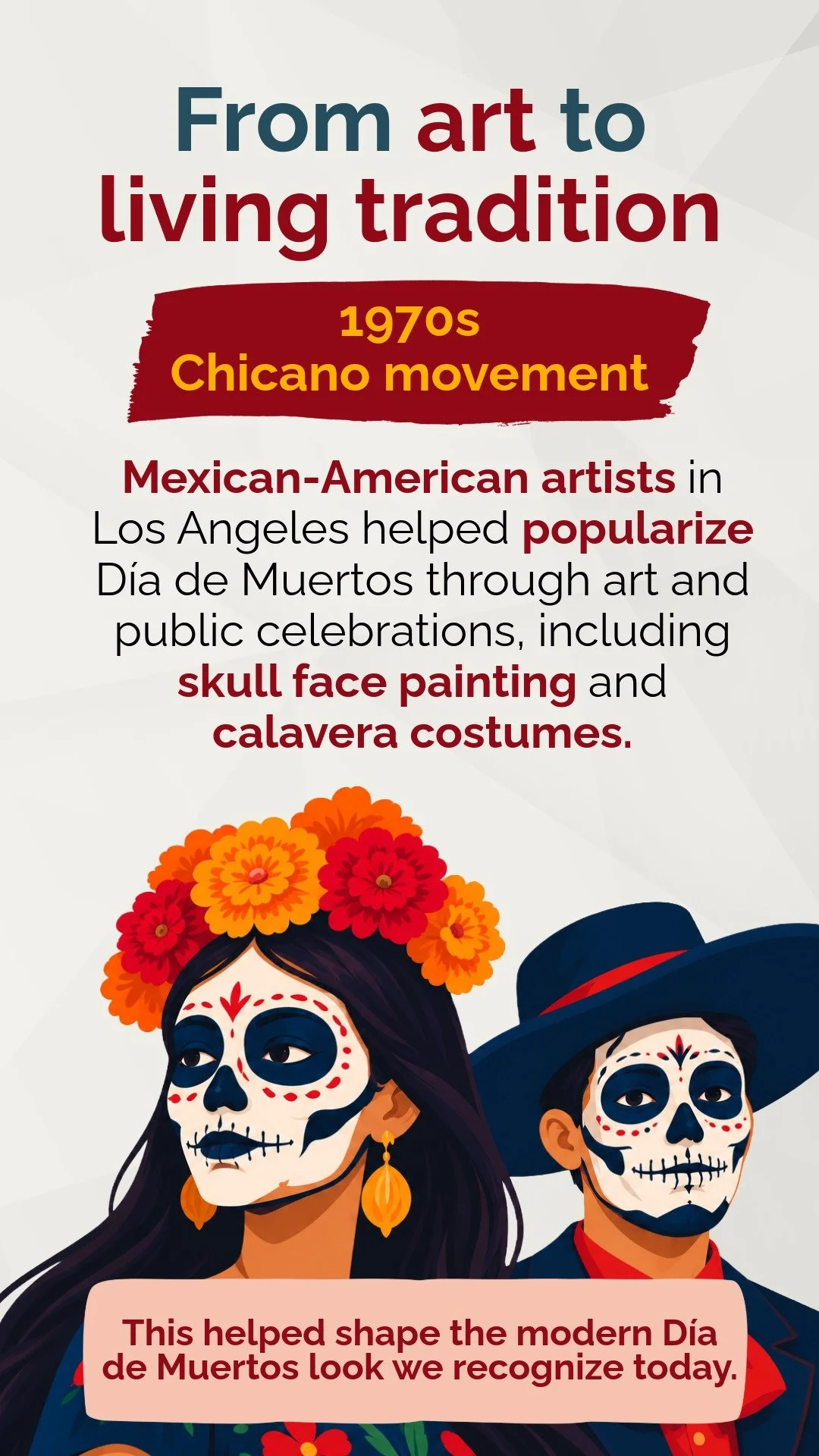
I had heard the word Chicano before, but I had no idea where it came from or the history behind it. Chicano is a term used by some Mexican-Americans to describe their cultural identity. Its exact origins are unclear, although one common explanation connects it to the word Mexicano. The term existed long before the 1960s, sometimes with negative connotations, but it was reclaimed as a symbol of cultural pride and identity during the Chicano movement, a Mexican-American civil rights and cultural movement that gained momentum in the United States during the 1960s and 1970s.
Art played a huge role, and Chicano artists in Los Angeles helped bring Día de Muertos into public spaces through processions, artwork and community celebrations. Drawing on traditional calavera imagery, these public celebrations helped popularize skull face painting and elaborate costumes, shaping the celebrations we recognize today.
Is dressing up as La Catrina cultural appropriation?
This is a question that comes up often, especially when living outside of Mexico.
I personally love seeing people being curious about Día de Muertos celebrations. I believe appreciating a culture comes from learning about its traditions, understanding their meaning and, above all, participating in a respectful way.
To me, dressing as La Catrina or El Catrín isn't automatically cultural appropriation. What matters is the intention and respect behind it. I don't appreciate seeing these images used for marketing purposes when their meaning is lost and they don't serve a cultural purpose.
Día de Muertos is about remembering and honouring those who have passed away, not simply dressing up for Halloween. However, going back to the Chicano movement and how culture spreads and crosses borders, I think dressing up and doing your makeup as La Catrina is a beautiful way to bring attention to this tradition and share it with others.
Día de Muertos today: A tradition that keeps evolving
Día de Muertos is celebrated differently across Mexico. Some families spend the night at cemeteries surrounded by flowers and candles. Others build altars at home. And there are also parades, festivals, art installations and costume celebrations.
You might have heard about the big Día de Muertos parade in Mexico City, and I have another fun fact for you. The parade actually started because of the James Bond movie Spectre (2015). If you've seen the movie, you might remember there's a huge Día de Muertos parade through Mexico City, except that parade didn't actually exist at the time. The city loved the idea so much that it organized its first official parade in 2016.
My personal take
Growing up, my family didn't have an ofrenda. We went to the cemetery, brought flowers and paid our respects. It was a beautiful family experience. It wasn't until I moved to Canada that I started making an altar, and it wasn't until I placed the photo of someone very dear to me on it that I truly understood its meaning.
For me, setting up an altar is a way for my children to create memories of their great-grandparents and grandfather.
In our home, we keep our ofrenda very simple: candles (fake, of course, I have small children!), papel picado, pictures, a few objects that remind us of what they liked, and food. And that last one is especially important because it's one of the ways my children get to know them.
When I bring out the pictures, I explain who they were and what they liked. A guitar for my grandpa, playing cards for my grandma. And when we put out the food, I share it with my children so they can associate those flavours and smells with the people we're remembering.
Now my children know that my dad loved Lay's chips. And when they have them on another occasion, they remember that Grandpa liked them too, even though they didn't get to spend much time with him.
So, to me, Día de Muertos is more than a holiday. It has become an essential way to connect my children to their ancestors. And in a way, I think that's what this tradition has always been about.
Día de Muertos has survived centuries of change, and it continues to evolve. But at its heart, it's still about remembering the people we love and keeping their memory alive.
Sources & Further Reading
About the Author
Ana Miller is a Mexican-Canadian brand and visual designer, cultural storyteller, and founder of SOMOS. Originally from Mexico and now based on Vancouver Island, she uses her creative background to explore and celebrate Latin American culture, traditions, identity, and belonging.
Instituto Nacional de Antropología e Historia (INAH). El origen del Día de Muertos.
https://www.inah.gob.mx/especiales-inah/articulos/el-origen-del-dia-de-muertosSmithsonian Center for Folklife and Cultural Heritage. Altered Altars: The Changing Traditions of Día de los Muertos.
https://folklife.si.edu/magazine/altered-altars-changing-traditions-dia-de-los-muertosSecretaría de Cultura, Government of Mexico. La Catrina and Diego Rivera's Dream of a Sunday Afternoon in Alameda Central.
https://www.gob.mx/cultura/prensa/recorridos-especiales-por-el-mural-sueno-de-una-tarde-dominical-en-la-alameda-central-obra-en-la-cual-se-inmortalizo-a-la-catrina?idiom=es-MXSmithsonian American Art Museum. Traditions and Change: The Transformation of Día de los Muertos in the United States.
https://americanart.si.edu/blog/dia-de-los-muertos-united-statesRutgers University. How Día de los Muertos Festivities in the U.S. Connect to Questions of Power, Identity, History, Inclusion and Resistance.
https://sci.rutgers.edu/news/how-dia-de-los-muertos-day-dead-festivities-us-connect-questions-power-identity-history-inclusion-and-resistance